
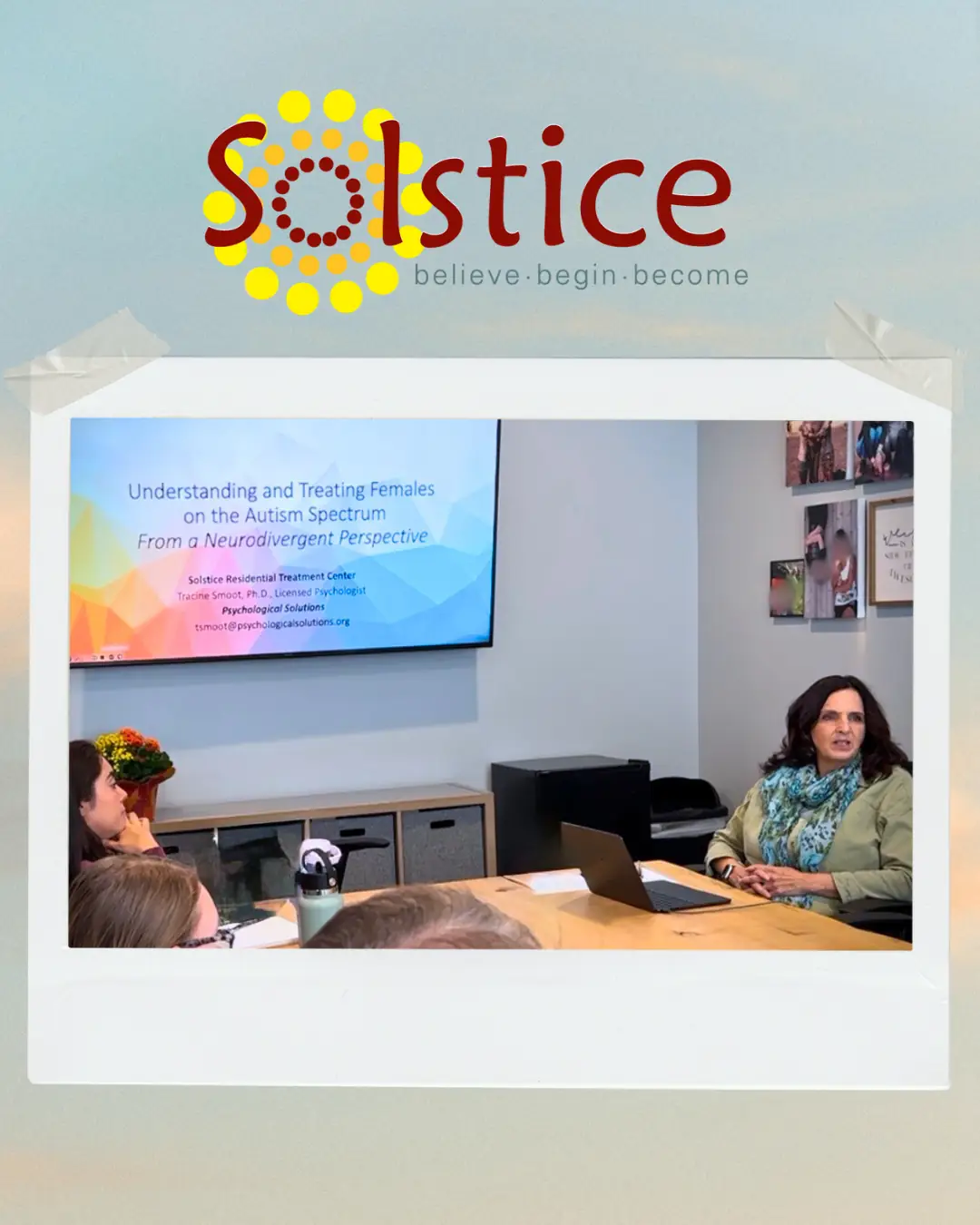
Staff at Solstice RTC recently attended a two-part autism training seminar led by Tracine Smoot, PhD, a licensed psychologist from Psychological Solutions. This seminar took place on October 23rd and 30th.
Dr. Smoot developed the seminar, titled "Understanding and Treating Females on the Autism Spectrum From a Neurodivergent Perspective," specifically for Solstice's unique population and mentors. The objective was to provide a resource that supports a clinically anchored perspective in working with neurodivergent youth.
The first day of training focused on understanding neurodivergence in general and the opportunities and challenges of autistic girls specifically. The focus helped staff distinguish spectrum behavior from other clinical issues. Staff explored the concept of the developmental "social dance" among neurodivergent youth, particularly within a predominantly female teen demographic. Key topics included masking, mirroring, and rejection sensitivity dysphoria.
The session concluded with an emphasis on recognizing youth within their "Zones of Proximal Development." Staff learned to address comfort, learning, and panic zones as youth work to improve how they regulate, relate, and grow.
After reflecting on the insights from Day One, the following session addressed specific treatment considerations related to autism. The session highlighted the importance of relationships, social skills, and attachment using the "circle of security" model. It focused on the personal experiences of neurodivergent youth — again with an emphasis on similarities and differences for female teens..
Clinical Director of Solstice, TJ Rowden, PhD, CMHC, shared, "We maintained a fundamental focus that treatment is NOT about what would make an individual more neurotypical, but on goals that help them feel their life is getting better and has meaning." The importance of embracing neurodivergent connection methods was highlighted, including "autism love languages" such as:
- shared or paralleled experiences,
- unmasking
- info dumping
- special interests
- "penguin pebbling"
- strategic stimming