
Solstice West RTC has successfully rolled out its updated clinical model and is now actively refining it through real-time feedback from students, families, and staff. (See the original press release here for more information.)
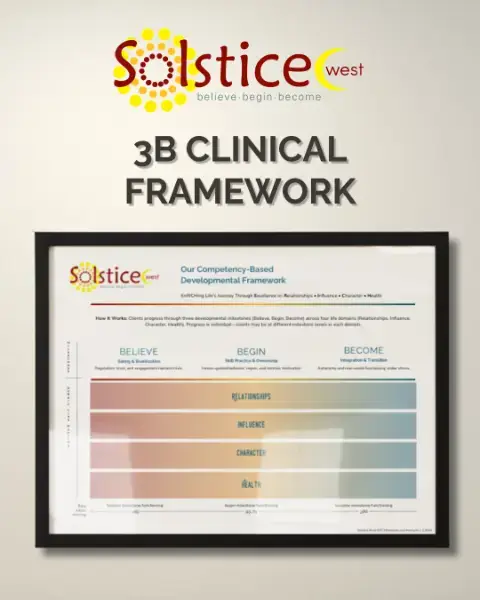
The model centers on a competency-based developmental framework: Believe, Begin, Become, guided by the EnRICH rubric (Excellence in Relationships, Influence, Character, Health). Unlike traditional phase-based systems, this approach measures progress through demonstrated skills, regulation, and relational functioning, rather than treatment time or compliance.
Executive Director, Jane Peterson, MSW, LCSW, “I think one of the key reasons our new programming will resonate with our clients, families, and treatment providers is that this is where treatment becomes about ‘real life’. It's now more about developing mastery in relationships that were lagging, resulting from trauma.
Meeting treatment milestones which are normative in nature will better prepare our students for success – helping them develop a healthy relationship with themselves, others and the way they navigate their world.”
Clinical Director TJ Rowden, PhD, CMHC, shares: “This change helps us answer the question families and clinical teams care most about: Is this student actually ready for life outside treatment? We’re now tracking that in a way that’s observable, individualized, and transferable beyond our campus."
What’s New Since Rollout
Following the initial rollout, Solstice is now focused on post-implementation optimization of its clinical framework, informed directly by student, staff, referring professional, and family feedback.
Rowden continued, “What we are seeing from our students is both nervousness of change yet tentative hope that the shift to 3B Milestones and EnRICH will indeed help them progress toward meaningful discharge, not just complying to get through treatment.
Our staff is reporting that there is a learning curve, but one that is empowering them in their relationship efforts with students. Instead of focusing on monitoring & managing student behavior, they are beginning to engage students more actively in discussing which RICH skills they are working on each shift, relevant to their goals of focus.
There is still ongoing training to assist students and mentors alike with the changes, but there is an overarching sense that instead of youth being largely focused on achieving phases for perks & privileges, bit by bit there is increasing focus on increasing trust, skill, capacity, readiness & relationships supporting change!”
This ongoing refinement is designed to improve how the model operates in daily practice, ensuring greater clarity, consistency, and clinical usefulness across the program. Early insights are helping the team fine-tune how progress is observed, communicated, and supported in real time.
This optimization builds on Solstice’s broader shift toward individualized progression, daily skill integration, and a unified approach to behavioral and substance-related challenges, strengthening alignment between treatment and real-world outcomes.
Clinical Positioning
Solstice continues to differentiate itself by treating behavioral and substance-related challenges through a shared regulation and trauma-informed framework, rather than siloed programming. This includes:
-
Focus on root drivers (trauma, attachment, affect regulation)
-
Use of skills-based and experiential therapies alongside trauma work
-
Emphasis on progress over perfection with functional outcomes
Family Seminar Integration
The March 2026 Family Seminar served as a key moment in bringing the updated clinical framework to life for families. Parents were introduced to how the model translates beyond the treatment setting, with a strong emphasis on regulation as the foundation for meaningful change. The seminar highlighted how daily routines, relational dynamics, and environmental structure all play a critical role in sustaining progress. Families also engaged in experiential work designed to deepen connection and shared understanding, reinforcing that growth is not linear and that setbacks are part of the learning process rather than indicators of failure.
Why It Matters for Referring Professionals
This rollout reflects a broader shift toward:
-
More accurate measurement of clinical progress
-
Stronger client buy-in to treatment plan
-
Better alignment between treatment and real-world outcomes
-
Stronger family integration and transition planning
Solstice is continuing to refine the model through ongoing feedback, focusing on improving consistency, clarity, and outcomes across the full continuum of care.
Solstice leadership will be attending the upcoming Autism Symposium in Rising Fawn, Georgia, April 20-22nd, 2026. Clinical Director TJ Rowden, PhD, CMHC, and Executive Director Jane Peterson, LCSW, invite clinical partners and consultants to connect with them directly to discuss the new framework, clinical applications, and how Solstice may support current or upcoming placements.
About Solstice West RTC:
Solstice West RTC is a residential treatment center for adolescents ages 12–18, specializing in substance use and process addictions: addictive or compulsive coping patterns rooted in trauma, attachment disruption, anxiety, depression, and loss. Our treatment approach is relationship-based, trauma-informed, and grounded in evidence-based modalities including DBT, CBT, EMDR, Brainspotting, Somatic Experiencing, experiential therapy, and family systems work.
Solstice West is fully licensed by the State of Utah, Office of Licensing, Department of Human Services, and accredited by Cognia, CARF, and recognized by California and Washington State for academic credit transfer.
Our campus is a private, gated community in Layton, Utah, with a capacity for 22 students.
Contact admissions for more info at: (866) 278-3345