

If you have ever sat across a conference table from a school team, surrounded by acronyms and paperwork, you know how quickly the alphabet soup of special education can become overwhelming. Two terms come up more than almost any others: 504 Plan and IEP. Parents often hear them used almost interchangeably, but they are not the same, and understanding the difference can genuinely change your child's experience at school and the support(s) your child might need.
They are BOTH legal documents and Civil Rights Law. Here is a plain-language breakdown of what each plan is, how they apply to some of the most common diagnoses families navigate, and what happens when a child ages out of the system.
The Basic Difference Between a 504 and an IEP
Both a 504 Plan and an Individualized Education Program (IEP) are legal frameworks designed to support students with disabilities in school. But they come from different laws, offer different levels of support, and carry very different obligations for schools.
504 Plan
A 504 plan comes from Section 504 of the Rehabilitation Act of 1973, a civil rights law that prohibits discrimination against people with disabilities. It's designed to level the playing field — to remove barriers so a student with a disability can access the same educational environment as everyone else. Accommodations under a 504 might include extended time on tests, preferential seating, or permission to use noise-canceling headphones. The school is required to provide these supports, but there's no specialized instruction involved and no formal measurement of progress toward specific goals.
IEP — Individualized Education Program
comes from the Individuals with Disabilities Education Act (IDEA), a federal special education law. An IEP goes significantly further than a 504. It's a legally binding document that outlines not just accommodations but also specialized instruction, measurable annual goals, related services (such as speech or occupational therapy), and how progress will be tracked and reported. To qualify for an IEP, a student must have a disability that falls into one of 13 eligibility categories defined by IDEA, and that disability must adversely affect their educational performance.
A useful way to think about it is this: a 504 plan outlines how a student will access the classroom. An IEP says what specialized support the student will receive, from whom, and how you'll know it's working.
One of the most important distinctions between the two frameworks is how they define eligibility — and those definitions are quite different.
Under Section 504, the bar is intentionally broad: a student qualifies if they have any physical or mental impairment that substantially limits a major life activity. That can include learning, concentrating, reading, communicating, sleeping, or caring for oneself. This wide definition is why conditions like ADHD, anxiety, diabetes, or even severe allergies can qualify a student for a 504 — there's no required category, just documented impact on daily functioning.
Under IDEA, eligibility is more specific. A student must fall within one of 13 defined disability categories — including autism, specific learning disability, emotional disturbance, other health impairment, speech or language impairment, and traumatic brain injury, among others — and the disability must adversely affect educational performance, requiring specialized instruction. Not every diagnosis automatically translates into IEP eligibility; the educational impact piece matters just as much as the diagnosis itself. The U.S. Department of Education provides detailed guidance on both laws, including how eligibility is determined under each framework and what rights families have throughout the process.
What Does This Mean for a Child with ADHD?
ADHD is one of the most common reasons families find themselves navigating this process — and also one of the most misunderstood in terms of which plan actually fits.
Many children with ADHD qualify for a 504 Plan, particularly when their primary challenges are attention and focus rather than academic skill deficits. A 504 for ADHD might include: extended time on assignments and tests, shortened or chunked assignments, frequent check-ins from a teacher, permission to take movement breaks, or preferential seating away from distractions. These accommodations can make a meaningful difference for a student who is fully capable academically but struggles to demonstrate that capability in a standard classroom environment.
However, some children with ADHD also qualify for an IEP — particularly when ADHD co-occurs with a learning disability like dyslexia, or when the impact on educational performance is significant enough that accommodations alone aren't sufficient. In those cases, a student might qualify under the "Other Health Impairment" (OHI) category and receive specialized instruction in addition to accommodations.
The key question isn't what the diagnosis is — it's what this child needs to learn. If the answer is "a fair environment," a 504 may be the right fit. If the answer is "a different kind of teaching," the conversation should turn toward an IEP.
What Does This Mean for a Child with Anxiety?
Anxiety is complicated in the school context, partly because it doesn't always look like what parents expect and partly because schools vary widely in how seriously they take it as an educational barrier.
For many students with anxiety, a 504 Plan is the starting point and may be entirely appropriate. Common 504 accommodations for anxiety include: advance notice of schedule changes, the ability to take tests in a quieter setting, access to a trusted adult when feeling overwhelmed, reduced homework load during high-stress periods, and the option to step out of class briefly when anxiety spikes. These accommodations don't change what the student is expected to learn — they change the conditions under which learning happens.
When anxiety is severe enough to significantly disrupt a student's ability to access education, through chronic school avoidance, panic attacks that prevent participation, or academic performance that has genuinely suffered, an IEP may become the more appropriate framework. Under an IEP, a student with anxiety might receive counseling services as a related service, social-emotional goals, a transition plan for returning after an absence, or support from a behavior specialist.
One important nuance: anxiety is not one of the 13 IDEA eligibility categories on its own, but it can qualify a student under "Emotional Disturbance" or "Other Health Impairment," depending on how it manifests and what documentation is available. Families should work closely with the school team and, ideally, outside clinicians to build a clear picture of educational impact.
What Does This Mean for a Child with Autism?
Autism is one of the 13 specific eligibility categories under IDEA, which means a student with an autism diagnosis who requires specialized instruction is typically a strong candidate for an IEP rather than a 504 alone.
An IEP for a student with autism is often comprehensive. It may include goals across multiple areas — communication, social skills, behavior, and academic skills and may incorporate a range of related services: speech-language therapy, occupational therapy, social skills groups, or applied behavior analysis. The IEP will also address how the student will be supported in the general education environment and, when appropriate, what percentage of the day they'll spend in different settings.
A 504 Plan is generally not the primary tool for students with autism who need significant support, simply because 504s don't provide specialized instruction or related services, which are often central to what autistic students need. That said, a student with a mild autism profile who is succeeding academically and primarily needs environmental accommodations might use a 504, though this is the exception rather than the rule.
Families navigating this process should know that they have the right to request a formal evaluation for special education services at any time, in writing. The school has a legal obligation to respond.
Because autism exists on a spectrum, the level of support a student needs — and therefore whether a 504 or IEP is appropriate — can vary enormously. To learn more about how autism presents across different levels, these resources may help:
When Does an IEP End?
This is a question families don't always think to ask until they're close to the answer — and it can catch people off guard.
An IEP remains in effect as long as a student is in a K–12 public school and continues to qualify for special education services. The IEP team meets at least annually to review and update the plan, and a full reevaluation of eligibility must happen at least every three years (sometimes called a "triennial" or "three-year re-eval"). (As a parent if you need to have a meeting in-between the annual, reach out to the school VIA EMAIL, in writing and request with your detailed reasons why the document needs to be looked at again.)
An IEP ends in one of a few ways:
-
The student no longer qualifies. If a reevaluation shows the student has made sufficient progress to no longer meet the eligibility criteria, services may be discontinued.
-
The student graduates with a standard diploma. This is the most common endpoint. When a student earns a regular high school diploma, IDEA services end.
-
The student ages out. IDEA covers students through age 21 (in most states). If a student has not graduated by 21, they age out of eligibility.
It is worth noting that a 504 Plan, unlike an IEP, can technically follow a student into college, though it looks very different in a higher education context and requires the student to self-advocate and request accommodations directly through the disability services office.
For families whose children are transitioning out of an IEP, beginning at age 16 (and sometimes earlier), the IEP is required to include a transition plan — goals and services oriented toward post-secondary education, vocational training, or independent living. This is an important planning tool, and families should engage with it actively.
It is also important for families to understand that for some young people — particularly those with intellectual disabilities, significant developmental delays, or complex support needs — the end of an IEP doesn't mean the end of services. It means the source of those services changes. Once a student ages out of the school system, support shifts to adult services agencies, which vary significantly by state. Vocational rehabilitation programs, state developmental disability agencies, and community-based organizations can provide ongoing support for life skills, employment, housing, and independent living. The catch is that these systems are not automatic; families typically need to apply, get on waiting lists, and advocate proactively, often years before the IEP actually ends. If your child will need lifelong support, beginning that transition planning well before age 21 is not just advisable, it is essential.
Understanding the difference between a 504 and an IEP won't make school meetings less intimidating overnight, but it gives you something essential: a foundation for asking the right questions. And in this process, knowing what to ask is everything.
When School-Based Support Isn't Enough
For some families, the question isn't just which plan fits; it's whether the school system will recommend that level of care for your child’s needs. In certain circumstances, school districts can be required to cover the cost of residential treatment, therapeutic boarding schools, or other out-of-district placements when a child's needs cannot be appropriately met in a traditional school setting. It takes time. It is a conversation more families should be having, and one that few know how to start. If you are uncertain about how to have these conversations, review the questions below.
Questions for parents to ask.
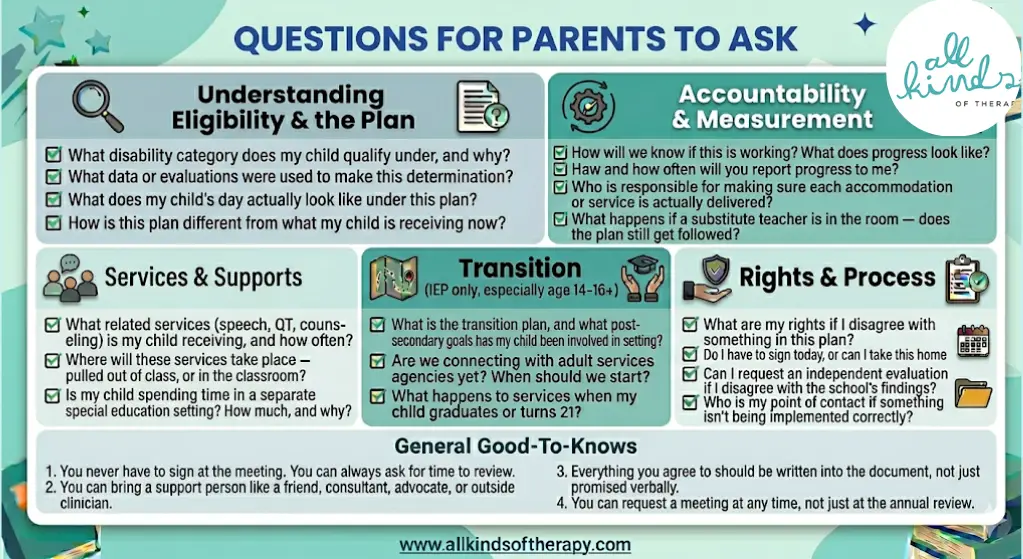
Understanding Eligibility & the Plan
-
What disability category does my child qualify under, and why?
-
What data or evaluations were used to make this determination?
-
What does my child's day actually look like under this plan?
-
How is this plan different from what my child is receiving now?
Accountability & Measurement
-
How will we know if this is working? What does progress look like?
-
How and how often will you report progress to me?
-
Who is responsible for making sure each accommodation or service is actually delivered?
-
What happens if a substitute teacher is in the room — does the plan still get followed?
Services & Supports
-
What related services (speech, OT, counseling) is my child receiving, and how often?
-
Where will these services take place — pulled out of class, or in the classroom?
-
Is my child spending time in a separate special education setting? How much, and why?
Rights & Process
-
What are my rights if I disagree with something in this plan?
-
Do I have to sign today, or can I take this home to review?
-
Can I request an independent evaluation if I disagree with the school's findings?
-
Who is my point of contact if something isn't being implemented correctly?
Transition (IEP only, especially age 14–16+)
-
What is the transition plan, and what post-secondary goals has my child been involved in setting?
-
Are we connecting with adult services agencies yet? When should we start?
-
What happens to services when my child graduates or turns 21?
General good-to-knows (what I share with my friends & family):
-
You never have to sign at the meeting. You can always ask for time to review.
-
You can bring a support person — a friend, advocate, or outside clinician.
-
Everything you agree to should be written into the document, not just promised verbally.
-
You can request a meeting at any time, not just at the annual review.
If you are wondering whether your child's school system might help pay for treatment or a more intensive placement, this is a good place to begin: Can Your School System Help With Treatment Options? 8 Questions To Ask
And if you're already exploring what higher levels of care look like for your child, All Kinds of Therapy's directory can help you find them, should the IEP not be enough.
As robust as this blog is, this is the law we are discussing, and it is in your best interest to consult or hire an attorney who specializes in Education Law. Visit wrightslaw.com to learn how your state handles special education cases like your child’s.
Explore treatment programs by age:
✅ Pre-Teen Treatment or Transitional Living
✅ Teen Treatment or Transitional Living
✅ Young Adult (18 – 30+) Treatment or Transitional Living
About the Author
Jenney Wilder, M.S.Ed., founded All Kinds of Therapy in 2015, closing her therapeutic educational consulting practice to build an unbiased resource families could actually trust. With an early career in Silicon Valley during the Web 1.0 era and a wonderfully diagnosed case of ADHD fueling her determination, she understood that the internet is the first place parents turn in crisis, and she was determined to build something worthy of that moment. Over the course of her career, she has personally visited more than 500 schools and treatment providers across all levels of care throughout North America. All Kinds of Therapy features transparent mental health, dual-diagnosis, and therapeutic programs and Expert professionals across all levels of care, free to parents and young adults, because finding the right treatment or transition program starts with asking the right questions and getting direct answers. A co-founder of the Therapeutic Consulting Association (TCA), she is also the lead author of the only collaborative economic impact study on adolescent and young adult treatment programs in Utah. She holds a Master's degree in Special Education from Bank Street College of Education (NY) and a B.A. from Wheaton College (MA).