

I want to start with the phrase itself, because it trips people up. "Quiet BPD" sounds like a milder version of borderline personality disorder. It is not. It is the same intensity, turned inward instead of outward. A young adult with quiet BPD may look composed, agreeable, even easygoing, while carrying the same emotional storms as someone with classic BPD. The storm just never leaves the house.
The term itself took off online largely because it named something a lot of people were already living without a word for. Individuals whose BPD symptoms turn inward are frequently misdiagnosed with major depression, bipolar disorder, or an anxiety disorder instead, since their presentation does not match the classic stereotype of BPD as visibly volatile or confrontational. "Quiet BPD" gave people language to make sense of an internal experience that traditional descriptions of BPD never seemed to capture.
What Is Quiet BPD?
Quiet BPD is not a separate diagnosis. I want to be direct about that, because a lot of what circulates on social media implies otherwise. Quiet BPD remains a descriptive term rather than a formal diagnosis. The DSM-5 recognizes one diagnosis: borderline personality disorder. "Quiet BPD," sometimes called high-functioning BPD or discouraged BPD, describes a presentation of that same diagnosis, one where the person directs their pain at themselves rather than at the people around them.
The word "borderline" itself dates back further than most people expect. American psychoanalyst Adolph Stern first proposed the term in 1938 to describe patients who did not fit cleanly into either the psychotic or the neurotic category of his era, hence "border-line." It took another three decades before the concept moved from clinical observation to actual research, when Roy Grinker and his colleagues published the first empirical study of the disorder in 1968. That history matters here because it is a reminder that our understanding of BPD, quiet or otherwise, has always evolved as clinicians paid closer attention to how the disorder actually shows up in real patients. (History of Borderline Personality Disorder)
Where a person with classic BPD might externalize distress through outbursts, confrontation, or visible instability, a person with quiet BPD tends to internalize it. Instead of lashing out, they shut down. Instead of a public argument, they replay the conversation alone for hours, certain they ruined everything. The suffering is not smaller. It is simply invisible to everyone but the person living it.
This matters enormously for families. A young adult who never raises their voice, who holds down a job or stays on top of school, who seems fine, can still be in genuine crisis. Quiet BPD is one of the more commonly missed mental health presentations precisely because it does not match what most people picture when they hear "borderline."
Quiet BPD Symptoms According to the DSM
Because quiet BPD is a presentation rather than its own diagnostic category, a clinician still evaluates it against the DSM-5 criteria for borderline personality disorder. A diagnosis requires meeting at least five of the following nine criteria:
-
Frantic efforts to avoid real or imagined abandonment
-
A pattern of unstable, intense relationships, often swinging between idealizing and devaluing someone
-
An unstable sense of self or identity
-
Impulsivity in at least two areas that could be self-damaging (spending, substance use, binge eating, reckless driving, and similar)
-
Recurrent suicidal behavior, gestures, threats, or self-harm
-
Marked mood reactivity, with intense episodes lasting hours to a few days
-
Chronic feelings of emptiness
-
Intense, difficult-to-control anger
-
Transient, stress-related paranoid thoughts or dissociation
In quiet BPD, these same nine criteria are present, but several tend to be expressed inwardly. Criterion 8, anger, often looks like self-directed rage or shame rather than outbursts at others. Criterion 2, unstable relationships, may show up as silent withdrawal rather than open conflict. Criterion 1, fear of abandonment, often stays unspoken, masked by people-pleasing rather than protest. The DSM does not separate these out. A clinician has to know what to look for.
What Tests Are Used to Assess Quiet BPD?
There is no single blood test or scan for BPD of any kind. Diagnosis relies on a thorough clinical evaluation, usually conducted by a psychiatrist, psychologist, or licensed clinical social worker trained in personality disorders. That evaluation typically includes:
-
A clinical interview. The clinician asks detailed questions about relationship patterns, self-image, emotional regulation, and history of self-harm or suicidal thoughts, often across more than one session.
-
Structured or semi-structured diagnostic tools, such as the Structured Clinical Interview for DSM-5 Personality Disorders (SCID-5-PD) or the Diagnostic Interview for Borderlines-Revised (DIB-R).
-
Self-report questionnaires, such as the McLean Screening Instrument for BPD (MSI-BPD) or the Personality Diagnostic Questionnaire, which help surface internal experiences that would not otherwise come up in conversation.
-
A review of history, including family background, past treatment, and any co-occurring conditions like depression, anxiety, or complex PTSD, since these frequently overlap with quiet BPD and can mask it.
Because a person with quiet BPD often presents as calm and articulate in a single session, an evaluator has to actively probe for the internal experience rather than rely on outward presentation. This is one reason quiet BPD is so often misdiagnosed as depression or anxiety alone.
Signs of Quiet Borderline Personality Disorder
For a parent, the signs of quiet BPD rarely look like a crisis from the outside. I would point families toward patterns like these:
-
Sudden, unexplained withdrawal from friends, family, or activities they used to care about
-
Chronic people-pleasing and a strong aversion to conflict, even at real personal cost
-
Harsh, ongoing self-criticism, far beyond what the situation calls for
-
Intense fear of rejection, even when nothing in the relationship has actually changed
-
A persistent sense of emptiness or numbness, sometimes described as feeling like nothing matters
-
Perfectionism paired with private despair, where outward achievement hides private self-loathing
-
Self-harm or suicidal thoughts kept hidden, often discovered only by accident
-
Dissociation, a feeling of being disconnected from oneself or watching life from a distance
A young adult showing several of these patterns, especially self-directed anger and hidden emotional pain, deserves a real evaluation rather than a wait-and-see approach. High-functioning does not mean low-risk.
Quiet BPD vs. BPD
The clearest way I can put it: quiet BPD and classic BPD share the same nine criteria, the same underlying instability in relationships, self-image, and emotion. The difference is direction. It is important to remember that Quiet BPD is a descriptive term. A diagnosis comes when the behaviors are impacting your child’s life inside and outside the home.
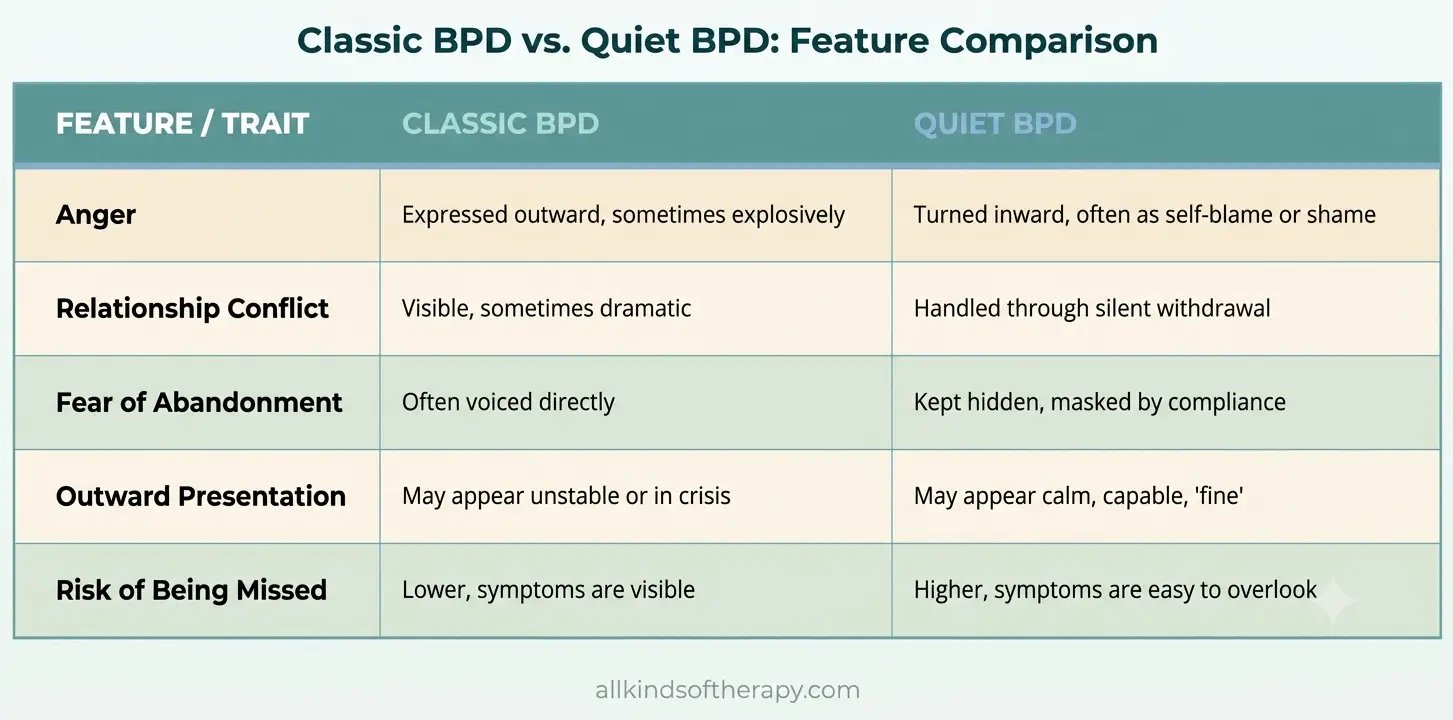
Neither presentation is more or less serious. Both carry real risk, including for self-harm and suicidal ideation. Quiet BPD simply asks more of the people around the person, because there is no obvious signal telling you to pay attention.
If You Recognize Quiet BPD In Your Child
A diagnosis, quiet or otherwise, is the beginning of a treatment plan, not a life sentence. Several types of outcome-based clinical treatments are used to work with BPD presentations, each built around a core set of skills.
Dialectical behavior therapy (DBT) remains the strongest evidence-based approach because of its core skill modules: mindfulness, distress tolerance, emotional regulation, and interpersonal effectiveness, which can be taught in outpatient therapy, PHP, or IOP. Related approaches include Radically Open Dialectical Behavior Therapy (RO-DBT) and mentalization-based therapy, and when needed, a higher level of care.
An example of an IOP/PHP model for adolescents is Aerie Healthcare (Concord or Newington, NH), and if your teen child is struggling and and you need day treatment or residential Skyland Trail (Atlanta, GA) for short-term treatment, or Sunrise RTC (Washington, UT), which is one of the only fully adherent residential DBT programs for teen girls, built on the four pillars of DBT: skills, consultation, phone coaching, and individual therapy. Solstice RTC (Utah) is a residential treatment center with DBT skills as a core modality, alongside CBT and REBT.
There are several options and different levels of care on All Kinds of Therapy for the young adult who has symptoms or might have a recent diagnosis; explore the partner's non-profit New Roads Behavioral Health (Cottonwood Heights, UT), which is DBT-Linehan Board of Certification (DBT-LBC), and has several levels of care including virtual services and residential treatment. The Mental Health Collective (Newport Beach, CA), where DBT skills are integrated with family-focused therapy and motivational interviewing (MI), or Engage Young Adult Transitions (Cedar City, UT), a transitional living program for young adults that includes DBT skills alongside CBT and case management support.
If you are interested in more information or have questions about your own child, adult, or adolescent, call a mental health professional.
About the Author
Jenney Wilder, M.S.Ed., founded All Kinds of Therapy in 2015, closing her therapeutic educational consulting practice to build an unbiased resource families could actually trust. With an early career in Silicon Valley during the Web 1.0 era and a wonderfully diagnosed case of ADHD fueling her determination, she understood that the internet is the first place parents turn in crisis, and she was determined to build something worthy of that moment. Over the course of her career, she has personally visited more than 500 schools and treatment providers across all levels of care throughout North America. All Kinds of Therapy features transparent mental health, dual-diagnosis, and therapeutic programs and Expert professionals across all levels of care, free to parents and young adults, because finding the right treatment or transition program starts with asking the right questions and getting direct answers. A co-founder of the Therapeutic Consulting Association (TCA), she is also the lead author of the only collaborative economic impact study on adolescent and young adult treatment programs in Utah. She holds a Master's degree in Special Education from Bank Street College of Education (NY) and a B.A. from Wheaton College (MA).